|



Version fran�aise
----
Version anglaise du
texte
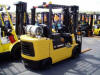
More than 500,000 forklifts are
powered by propane in factories and warehouses. And it's no wonder.
Propane-powered forklifts provide operational options and economic
advantages that make them a clear choice for your material handling
needs.
The
reasons for choosing propane forklifts and for converting existing
gasoline forklifts to operate on propane are plentiful.
|
|
 |
 |
Environmentally Friendly: Propane is a
non-toxic,
clean-burning fuel that can be used to safely power forklifts both
indoors and outdoors. With propane, there is no spillage loss or
evaporation into the atmosphere.
|
|
|
Safe: Propane forklift tanks, fuel lines and carburetion
components meet or exceed strict specifications. Built-in safety
devices automatically shut off the flow of fuel in case of an
accident.
|
|
|
Versatile: Propane forklifts can be used in indoor and
outdoor applications. Propane is the most portable fuel �
cylinders can be stored and moved virtually anywhere within a work
site.
|
|
|
Strong: Propane forklifts maintain consistent, 100-percent
power throughout operation. They have the ability to push and pull
heavy loads at full capacity, up and down inclines, for a longer
amount of time, and with better ground speeds than electric
forklifts.
|
|
|
Easy Refueling: Propane forklifts require very little
refueling time compared to natural gas-powered and electric
forklifts.
|
|
|
Economical: From an investment
standpoint, propane
forklifts offer an economical way to meet material handling needs.
Propane forklifts have lower life-cycle costs than electric, diesel
or gasoline-powered forklifts.
|
|
|
Low Maintenance: Propane produces fewer engine deposits
than gasoline and diesel fuel, resulting in lower maintenance costs.
Propane engines can typically last up to twice as long as gasoline
engines.
|
Comparison
of Forklift Attributes
| Fuel |
Versatility |
Cost |
| Propane |
�
Indoor and outdoor use
� Capable of handling rugged, unpaved, outdoor terrain, and
steep grades
� Can operate in inclement weather
|
�
Lower initial investment costs than comparable electric, CNG or
diesel forklifts
� Lower maintenance costs than diesel and electric forklifts
� Inexpensive cylinder exchange or onsite fuel storage
� Pilfer-proof; reduced loss from spillage and evaporation
|
| Diesel |
�
Predominantly outdoor use only |
�
Additional cost due to pilfering, spillage losses, evaporation |
| CNG |
�
Similar to propane |
�
Recertification costs: CNG cylinders must be recertified every
three years
� Establishments with CNG forklift fleet may require major
capital investment of up to $40,000 in refueling station
� If the electric service goes down, the CNG compressor
station will not work resulting in a potentially significant
production loss
� CNG compressors are expensive to overhaul
|
| Electricity |
�
Typically for indoor use
� Operate only on paved or hard surfaces
� Cannot handle steep inclines
|
Higher
initial investment due to:
� Extra equipment such as batteries, charger, and battery
hoist, battery charging and wash down rooms
� Additional indoor space for recharger and battery storage
� Labor costs for changing batteries for second and third
shifts
� Ventilated storage area is required for batteries
|
| Gasoline |
Typically
for outdoor use |
�
Additional cost due to pilfering, spillage losses, evaporation
� High costs to upgrade on-site fuel storage
|
Comparison
of Forklift Operating Characteristics
| Fuel |
Power |
Approximate
Operating Time (Per Tank or Battery) |
Maintenance |
| Propane |
�
Speed (max): 9.5-10.5 mph
� Lift (loaded): 83-88 fpm
� Maintains 100% power consistently throughout full operation
|
8
hours (1 shift) |
�
Easy maintenance
� Maintenance intervals may be extended because of propane's
clean-burning characteristics
|
| Diesel |
�
Speed (max): 9.5-10.5 mph
� Lift (loaded): 83-88 fpm
|
8
hours (1 shift) |
�
Requires expensive oil changes
|
| CNG |
�
Speed (max): 9.5-10.5 mph
� Lift (loaded): 74-78 fpm
|
2-4
hours (�- � shift) |
�
Requires frequent refueling
� CNG compressors will require expensive overhaul
|
| Electricity |
�
Speed (max): 8-9 mph
� Lift (loaded): 83-88 fpm
� Loses power as battery discharges
|
6-8
hours (�- 1 shift) |
�
Requires additional training
� Maintenance intervals depend on conditions
� Must operate in a controlled environment (e.g., not in the
rain)
� Second and third shifts requires labor for battery change
|
| Gasoline |
�
Speed (max): 9.5-10.5 mph
� Lift (loaded): 83-88 fpm
|
8
hours (1 shift) |
�
Requires more frequent oil changes than propane
|
Source:
National Propane Gas Association
There are seven classes of forklifts:
|
|
Class 1: Electric
motor, sit-down rider, counterbalanced trucks
(both solid and pneumatic tires) |
|
|
Class 2: Electric
motor, narrow aisle trucks (solid tires) |
|
|
Class 3: Electric motor hand trucks or hand/rider trucks (solid
tires) |
|
|
Class 4: Internal combustion engine trucks (solid tires) |
|
|
Class 5: Internal combustion engine trucks
(pneumatic tires) |
|
|
Class 6: Electric & internal combustion engine tractors (both
solid and pneumatic tires) |
|
|
Class 7: Rough terrain forklift trucks
(pneumatic tires) |
Propane forklifts are primarily Class 4 and Class 5 forklifts.

MSDSpropane
Info_an.pdf Infos an.
Propane, propri�t�, m�sures de s�curit�, etc.
FDSPropane15Sept03_fr.pdf Fiche de donn�es de s�curit� Propane fr.
Classement des chariots selon l'Industrial Truck
Association (ITA) Voir: classement_chariots
24/01/12
|
|

 Nous sommes le
Jeudi 31 Aout 2017 et il est 15:49:54
Nous sommes le
Jeudi 31 Aout 2017 et il est 15:49:54








 Graphisme
Concept: Webmestre
Graphisme
Concept: Webmestre